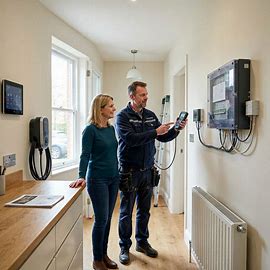
How Much Does an EV Charger Cost?
A standard 7kW home EV charger typically costs around £800–£1,200 fully installed in the UK, covering the unit and the fitting. The final price depends on your cable run, fuse box and any extra electrical work, with grants available for some households.💡 Want a price for your home? Every property is different. Get a free, no-obligation quote tailored to your home — takes 2 minutes.
The Typical Cost
For most UK homes, a standard 7kW smart charger costs around £800–£1,200 fully installed. That usually splits into roughly £400–£700 for the charger unit itself and £400–£500 for the installation. In London and the South East, the same job often runs higher, around £900–£1,500. A 7kW unit is the standard choice because nearly all UK homes have a single-phase supply, and 7kW comfortably charges most cars overnight. Faster 22kW units need a three-phase supply, which most homes don’t have — and upgrading is rarely worthwhile for home charging.Considering Solar or Battery Storage?
Get a free, no-obligation quote tailored to your property.
What’s Included in the Price
A standard installation quote typically covers:-
- The charger unit: a smart 7kW wall-mounted charger.
- The cable run: a dedicated circuit from your fuse box to the charger.
- Mounting: fixing the unit securely to a wall or post.
- Testing & certification: commissioning by a qualified electrician.
- DNO notification: telling your network operator, as required.
What Changes the Cost
Two identical cars can get very different quotes, because installers price on the property, not just the unit.-
- Cable run length: a charger 5m from the fuse box is simple; 20–25m away can add £200–£400 in cable and labour.
- Consumer unit condition: an older fuse box may need upgrading — a separate cost.
- Earthing requirements: some setups need extra protection fitted.
- Groundworks: trenching or going under a driveway adds to the bill.
💡 Not sure what your setup needs? Every property is different. Get a free, no-obligation quote tailored to your home — takes 2 minutes.
Tethered vs Untethered
One choice that affects the unit price is whether the charger is tethered or untethered.-
- Tethered: a fixed cable, ready to plug straight in. Convenient, but typically £50–£150 more.
- Untethered: a socket you plug your own cable into. Tidier look and more flexible if you change cars.
Grants: Who Qualifies in 2026
There is a government EV chargepoint grant, but the rules are specific — and many homeowners don’t qualify. As of April 2026 the grant is worth up to £500 per socket, but it’s aimed at renters, flat owners, households with only on-street parking (using an approved solution), and residential landlords. Homeowners with a private driveway are not eligible — that scheme closed back in 2022. Where it applies, an OZEV-approved installer claims it on your behalf, and the current schemes run until 31 March 2027.Charging from Solar
If you have — or are planning — solar panels, a solar-compatible charger can use your surplus generation to charge the car, cutting running costs further. This adds a little to the unit cost but can pay off over time. Our guide to adding an EV charger to your solar system explains how it works, and our main EV charger installation guide covers the process end to end.Why Choose a Professional Installer?
-
- Legal requirement: EV chargers must be fitted by a qualified electrician.
- Safe installation: correct circuit, earthing and protection.
- DNO notification: handled properly on your behalf.
- NICEIC approved: work to recognised standards.
What Happens When You Request a Quote?
-
- Submit the form: tell us about your property and car.
- We review: our team looks at your setup and requirements.
- Free consultation: we discuss your options with no obligation.
- Tailored quote: you receive a solution designed around your specific needs.
💡 Ready for a fixed price? Every property is different. Get a free, no-obligation quote tailored to your home — takes 2 minutes.
Related Guides
Frequently Asked Questions
How much does it cost to install a home EV charger?
A standard 7kW smart charger typically costs around £800–£1,200 fully installed — roughly £400–£700 for the unit and £400–£500 for fitting. London and the South East often run higher. Extra electrical work is priced separately.Why do EV charger quotes vary so much?
Because installers price on your property. The cable run length, the condition of your fuse box, earthing requirements and any groundworks all affect the total — which is why a proper assessment beats a headline figure.Can I get a grant for a home EV charger?
Only some households. The grant (up to £500 per socket in 2026) is for renters, flat owners, those with on-street parking, and landlords. Homeowners with a private driveway aren’t eligible, as that scheme closed in 2022.Do I need a 7kW or 22kW charger?
For nearly all homes, 7kW — it charges most cars fully overnight and suits a standard single-phase supply. A 22kW charger needs a three-phase supply, which most homes lack, and upgrading is rarely worthwhile for home charging. Last updated: June 2026Disclaimer: This article is for informational purposes only. Energy savings estimates are based on industry averages and may vary depending on your property, energy usage, system size, and electricity tariff. We recommend obtaining a personalised quote for accurate savings estimates. Energy Solutions NW is part of the Blue Rock Energy network. MCS certified. NICEIC approved.