What Is a Consumer Unit Upgrade?
A consumer unit upgrade replaces an old fuse box with a modern board fitted with circuit breakers and RCD protection. It improves safety against shock and fire, meets current wiring regulations, and is often needed before adding an EV charger or extension.💡 Got an old fuse box? Every property is different. Get a free, no-obligation quote tailored to your home — takes 2 minutes.
What a Consumer Unit Does
The consumer unit is where your electricity supply enters the home and splits out to each circuit — lighting, sockets, cooker and so on. Modern units use miniature circuit breakers (MCBs) that simply reset after a trip, rather than old-style fuse wire you have to replace. More importantly, they include RCD protection, which cuts power in milliseconds if it detects a dangerous fault. Old rewireable fuses only protect against overloads and short circuits — not the kind of earth faults that cause electric shocks. That’s the core safety gap an upgrade closes.Considering Solar or Battery Storage?
Get a free, no-obligation quote tailored to your property.
When You Need an Upgrade
A few clear signals suggest it’s time:-
- Old-style rewireable fuses: ceramic or brown carriers with fuse wire — a strong sign of an outdated board.
- No RCD protection: common on boards 20–40 years old, leaving you less protected against shock.
- Frequent tripping: or a unit that buzzes, overheats or smells of burning.
- A failed or flagged EICR: an inspection may identify the board as needing replacement.
- Adding major load: an EV charger, extension or loft conversion often requires a modern unit.
RCD vs RCBO Boards
When upgrading, there’s a choice between two main types.-
- Dual-RCD board: circuits split across two RCDs. A fault trips one RCD and knocks out all the circuits on that side.
- RCBO board: each circuit has its own combined protection, so a fault only trips that single circuit.
💡 Not sure which board suits your home? Every property is different. Get a free, no-obligation quote tailored to your home — takes 2 minutes.
The Regulations
Consumer unit work is covered by current UK wiring regulations (BS 7671, 18th Edition), and a few points matter for any new install:-
- Metal enclosure: new units must be non-combustible (metal) to limit fire spread.
- RCD protection: required across circuits for shock protection.
- Surge protection (SPD): now expected in many homes, protecting sensitive electronics.
- Certification: the work is notifiable under Part P and must be tested and certified.
How Much Does It Cost?
For most homes, a consumer unit replacement costs roughly £450–£800 for a standard dual-RCD board, or around £800–£1,200 for a full RCBO board — including the unit, labour, testing and certification. London and the South East typically run higher. Surge protection, if added, is usually £50–£150 more. One honest note: once the cover comes off, testing sometimes uncovers wiring faults that must be made safe before the certificate can be issued — so it’s worth allowing a little flexibility in the budget.Fuse Boxes and EV Chargers
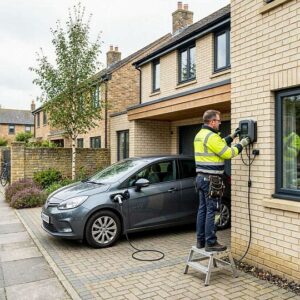
One of the most common reasons we’re asked about fuse box upgrades is EV charging. An EV charger adds a significant, sustained load, and an older board may not be able to handle it safely or have a spare way for the new circuit. In that case, upgrading the unit is part of getting your charger fitted properly. Our guide to EV charger costs covers how this fits into the overall price, and the home electrical upgrades hub pulls the related jobs together.Why Choose a Professional Installer?
-
- Legal requirement: the work is notifiable and must be certified.
- Proper testing: faults found and made safe before sign-off.
- Right specification: a board suited to your home and any future EV charger.
- NICEIC approved: registered electricians who can self-certify their work.
What Happens When You Request a Quote?
-
- Submit the form: tell us about your fuse box and any concerns.
- We review: our team looks at your setup and requirements.
- Free consultation: we discuss your options with no obligation.
- Tailored quote: you receive a solution designed around your specific needs.
💡 Ready to upgrade safely? Every property is different. Get a free, no-obligation quote tailored to your home — takes 2 minutes.
Related Guides
Frequently Asked Questions
When does a fuse box need upgrading?
Common triggers are old rewireable fuses, no RCD protection, frequent tripping, buzzing or burning smells, a flagged EICR, or adding a big load like an EV charger or extension. Boards 20–40 years old are often due an upgrade.How much does a consumer unit replacement cost?
Roughly £450–£800 for a standard dual-RCD board or around £800–£1,200 for a full RCBO board, including the unit, labour, testing and certification. London and the South East run higher, and surge protection adds £50–£150.What’s the difference between RCD and RCBO?
A dual-RCD board groups circuits, so one fault trips a whole bank. An RCBO board gives each circuit its own protection, so a fault only affects that single circuit. RCBO costs a little more but is more convenient and resilient.Do I need to upgrade my fuse box for an EV charger?
Sometimes. An EV charger adds a significant continuous load, and an older board may lack capacity or a spare way for the new circuit. An electrician will check whether your existing unit can handle a charger safely. Last updated: June 2026Disclaimer: This article is for informational purposes only. Energy savings estimates are based on industry averages and may vary depending on your property, energy usage, system size, and electricity tariff. We recommend obtaining a personalised quote for accurate savings estimates. Energy Solutions NW is part of the Blue Rock Energy network. MCS certified. NICEIC approved.